
Introduction
Making perfect fundraising Strategies for Nonprofits is a combination of multiple strategies. If a nonprofit organisation lacks a clear roadmap or doesn’t leverage smart techniques, fundraising will feel like selling ice in the North Pole. If you put in effort, energy, and work hard, make sure the results show up consistently.
In this article, we will explore how to build your perfect fundraising strategy for nonprofits with a clear roadmap, what to do and what not to do and the best path to choose for your nonprofit.
The Basic But The Most Important Task in Fundraising
Before starting the planning, you must answer these six basic questions first and work on the answers.
- Who Are You? What is your or your nonprofit’s mission? What problem do you solve, and why are you the best ones to do it?
- Do your Audience Research. Who donated earlier, how much, and through which channel?
- Set your Target. Whom Do You Like To Reach?
- What is yourSMART Goal?
- How to engage your donors ?
- How to automate the process ?
Some Mistakes That Most Nonprofits Make But You Shouldn’t
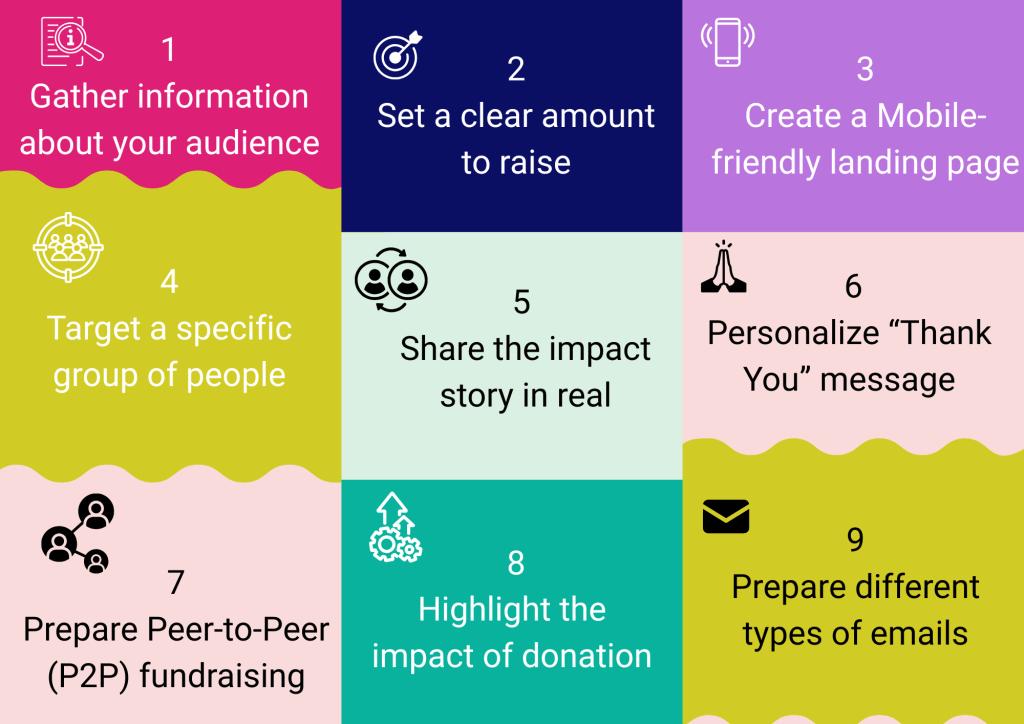
- If you are new in the nonprofit industry, don’t rush into campaign launching. Gather information about your audience. You can research similar nonprofits’ public reports.
- Make the number clear to yourself. Instead of “raise money,” set a goal like: “Raise $50,000 by Q4 to provide 500 clean water kits, with 20% coming from new recurring donors.”
- Ensure your landing page is mobile friendly and your form has fewer than 3 clicks to complete.
- Instead of targeting “everyone”, target a specific group of people who aligns with your strategy the best.
- Share “Evidence of Change or Impact” with real photos, videos and stories.
- Say “Thank You” within 36 hours to your donors. A personalized video or a short recording from a phone creates a greater impact on donor retention than saying nothing.
- Give importance to Peer-to-Peer (P2P) fundraising. We will discuss it in detail later in this article.
- Don’t say “Your money helps,” but you should say “Your $80 bought 12 vaccine doses for poor children.” Use “Impact Meters” on your website to show real-time progress.
- A donor who donates $10 monthly (recurring donor) and a one-time $1,000 donor are not the same. So always prepare different types of emails for your donors or prospects. Using automation tools will simplify and make the process more efficient.
Diversify Your Funding Strategy
When it comes to fundraising strategies for nonprofits, relying on a single grant or one big gala is not wise. You must think of gathering funds from different sources. Your nonprofit may have the best charity idea or a great mission and commitment, but, receiving funds is not completely up to you. So, you must plan healthy funding strategies for nonprofits with all possibilities explored.
Individual Donors:
Individual Donors are common people or private citizens who donate to a cause. They are called “The Backbone” of nonprofits. Because in most of the cases, they not only provide most of the funds but they also give emotional support being loyal supporters of the cause.
Benefits:
- It is a number game. Maybe the donation they make individually looks small but cumulatively the amount surpasses the donation amount received from other sources.
- The donation received is not restricted by any condition. You can wish it wherever and however you want
- Individual donors are the most reliable donors if their donation expectation aligns with your cause. They will promote your cause or mission for free and you can leverage their personal network too to further fundraising.
Crowdfunding or Peer to Peer fundraising becomes easier when you join hands with Individual Donors.
Corporate Sponsorships:
Corporate Sponsorships act as a high value inflow of funds. It is also a symbol of professional validation. You can partner with local businesses that align your values. Corporate sponsorships are technically business deals to promote their business in exchange for funding to nonprofits.
Benefits:
- Generally, corporate organizations sponsor a big amount. This acts as a booster in the mission or charitable project covering a major portion of the budget. This is often used to bear the costs of a seminar, a gala, a marathon, or a community festival.
- Corporate organizations sponsor their services also apart from hard cash, like, sponsoring food, venue, printed materials, electronic instruments or others depending on the business they are doing.
- Reputed companies add credibility to your mission and your nonprofit organization. The loyal consumers of the corporate organization also can be your future donors. Also, an extra value or trust factor is added into your fundraising drive if backed by a reputed brand.
- Some organizations provide skilled volunteers from their workforce which helps in fundraising or managing the project efficiently.
Grants:
Grants are financial support provided by government agencies, private foundations, or corporations to support specific projects. They play vital role in fundraising Strategies for Nonprofits, especially in executing big projects.
Grants are not easily available money, but they are powerful when done right.
Successful nonprofits research carefully and apply only to grants aligned with their mission.
Grant fundraising works best when paired with strong reporting and transparency. Funders want proof of impact.
Strategic Tips:
Never rely on grants for 100% of your budget. Because they are project-based and competitive, they can disappear once the grant cycle ends. A healthy nonprofit uses grants to scale impact while using individual donors to provide the small bills.
Earned Income:
Earned Income refers to the revenue that a nonprofit generates by selling goods or services, rather than receiving them as gifts or grants.
Nonprofits can raise money by Product Sales, Asset Rental, Offering Services or Consulting.
How to Choose Fundraising Strategies for Nonprofits
| Feature | Individual Donors | Corporate Sponsorships | Grants | Earned Income |
| Primary Goal | Long-term support & community | Marketing & Brand ROI | Large-scale project funding | Self-sufficiency & mission |
| Typical Amount | Small to Large (Scalable) | Large (Lump sum) | Very Large (Institutional) | Consistent (Based on sales) |
| Flexibility | High (Unrestricted) | Medium (Tied to event/PR) | Low (Highly restricted) | Highest (Use for anything) |
| Effort to Get | Medium (Relationships) | Medium (Business deals) | High (Technical writing) | High (Running a business) |
| Success Factor | Emotional connection | Mutual business benefit | Proven impact & data | Product/Service quality |
| Main Risk | Donor fatigue | Economic downturns | Competitive; may expire | Market competition/Tax |
Fundraising Strategies for Nonprofits That Deliver Real Results
Focus on Recurring Giving
One of the most successful non profit fundraisers is the monthly giving program. You should focus on it more because it provides “predictable revenue.” Depending on that you can prepare a year-long spending budget for your nonprofit organization, initiate a new project or make partnerships for growth.
Monthly funds, even if it is small, create more impact than one big amount.
Small, automated monthly gifts give you a sense of security and sustainability in comparison to a single large annual donation.
The Strategy:
Instead of asking for $100 once, ask for $10 a month.
Why it works:
It’s easier on the donor’s budget and keeps them engaged with your mission round the year.
Learn here how to launch recurring giving programs easily.
Peer-to-Peer Fundraising
Your current supporters are your best advocates. Leverage their network for your fundraising. Loyal supporters will share your mission if your organization’s mission and vision compels them, helping you in “peer-to-peer” (P2P) fundraising.
You can reach peers through emails or social media.
Here is your guide to launch an easy peer to peer campaign launching.
Practical Tip:
Use platforms like GiveCentral to make it easy for your supporters to set up their pages in minutes.
Sample Fundraising Plan for Beginners (The 12-Month Roadmap)
Fundraising strategies for nonprofits is no good if it’s not executed in time. Here is a sample fundraising plan to guide your through the year:
| Quarter | Focus Area | Key Activity |
| Q1: Foundation | Donor Stewardship | Send personalized “Impact Reports” to last year’s donors. |
| Q2: Growth | Acquisition | Launch a peer-to-peer spring campaign or a “Giving Day” campaign. |
| Q3: Grants | Sustainability | Research and apply for at least 3-5 major grants. |
| Q4: Retention | Year-End Appeals | Focus on GivingTuesday and holiday matching gift drives. |
Why Nonprofits Must Set a Clear Fundraising Strategy
Firstly, let’s learn what to follow in fundraising. Donors are the most important component in fundraising. If you can crack the psychology of giving to your target donors, the lion’s share of your work is done.
Understanding Donors
Donors are really smart. They expect transparency. They value impactful stories. And they want convenience.
So, donors want to feel special, they prefer digital engagement and easy but trustworthy payment options, respond to personal stories and expect regular updates.
According to data, consistent communication and trust are stronger drivers than one-time appeals. Smart fundraising strategies for nonprofits reflect this reality.
If you want a fresh bunch of fundraising ideas for the starting of the year 2026, click here.
Outreaching the Competition
Competition for attention is intense. Millions of nonprofits are seeking funding everyday. They are competing globally, not just locally.
Your nonprofit needs a sustainable plan; random campaign ideas are not going to work in the long run.
A clear funding strategy helps you in:
- Focus on the right donors
- Allocate resources wisely and timely
- Predict revenue and create a budget
- Make it easier to follow the roadmap
Conclusion
Successful fundraising in 2026 is no longer about the “hard sell”, it is about planning comprehensive fundraising strategies for nonprofits and executing it when the time comes. To raise funds, you must change your way from “asking for help” to “offering an investment opportunity.” In a world of compassion fatigue, donors don’t just want to give; they want to see measurable change that feels personal.
Relationship over revenue wins the game. When you treat a donor like a partner in change rather than a walking ATM, you can rely on them too. With some good fundraising strategies for nonprofits in your hand, stay consistent, tell great stories, and always express your gratitude.
Givecentral Training Session offers hands-on training to polish your fundraising skills. Learn what benefits it offer.
FAQ:
What are the essential initial questions a nonprofit must answer before developing a fundraising strategy?
Before starting your fundraising planning, you must answer six basic questions: Who are you and what is your mission, who is your target audience, what are your specific goals using SMART criteria, how will you engage your donors, and how can you automate the process?
What are common mistakes nonprofits should avoid when creating a fundraising campaign?
Nonprofits should avoid rushing into campaign launches without proper research, setting unclear goals, neglecting mobile-friendly landing pages, targeting everyone instead of specific groups, failing to share evidence of impact, and not thanking donors promptly or tailoring communication to different donor types.
Why is diversifying funding sources important for nonprofits?
Diversifying funding sources ensures stability and resilience since relying on a single source like a major grant or gala can be risky; exploring multiple avenues like individual donors, corporate sponsorships, grants, and earned income helps sustain and scale your nonprofit’s impact.
How can nonprofits effectively build relationships with individual donors?
Nonprofits should focus on creating emotional connections through impactful stories, maintaining regular transparent communication, providing convenient digital payment options, and recognizing donors promptly with personalized thank-you messages or impact updates to foster loyalty and ongoing support.
What is the significance of implementing recurring giving programs in nonprofit fundraising?
Recurring giving programs provide predictable and steady revenue, allowing nonprofits to plan budgets, initiate new projects, and build long-term relationships with donors, often with smaller monthly donations that collectively have a greater impact than one-time large gifts.

Last modified: February 3, 2026